The Squeeze: San Diego's Lemon Supply, By the Numbers

This week, a carton of California lemons is running $30 to $45 wholesale. A comparable carton from Mexico, Chile, or Argentina is running $16 to $28, according to the same USDA report, the same day. Same fruit, same grade, roughly double the price if it's grown here.
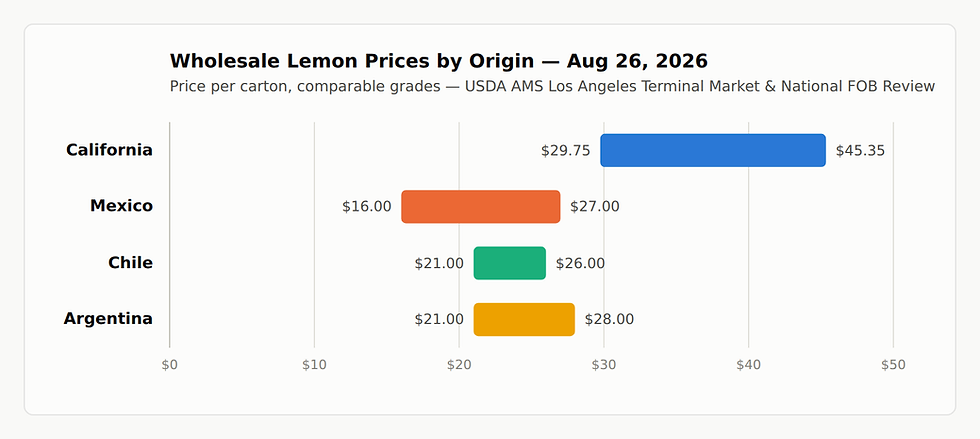
That gap comes from two different pressures stacked on top of each other. San Diego's lemon supply has been shrinking for sixteen years running, for reasons that mostly have nothing to do with disease. Separately, a citrus disease the county has watched for since 2013 just triggered another quarantine expansion in the towns that grow the fruit — a newer, still-small risk layered on top of an already-smaller crop. If you're pricing a cocktail menu, a juice program, or anything else that leans on citrus, the "local lemon" on your bar is a more complicated (and more expensive) story than it looks like on a menu.
Sixteen years, one direction
We pulled every County of San Diego Crop Statistics and Annual Report from 2009 through 2024. San Diego's lemon crop peaked in 2010, at 4,456 acres. By 2024 it was down to 2,495 acres — a 44% drop in the amount of land growing lemons here, in a little over a decade.
Zoom out to citrus overall — lemons, oranges, grapefruit, limes, tangerines, kumquats — and the picture holds. Total citrus acreage also peaked in 2010, at 14,287 acres, and fell in nearly every year since, down to 7,805 acres by 2024. A 45% decline from peak.

Meanwhile the price growers get per ton of lemons climbed from around $517 in 2009 to $1,905 in 2024, roughly 3.7 times higher, without production keeping pace. Less fruit, sold for more per ton: that's what a shrinking supply looks like from the outside. The county's own 2023 report puts it plainly, attributing that year's jump in citrus value to higher prices rather than a bigger crop.

Why the acreage keeps shrinking
None of the county's own numbers say why growers are planting less citrus — acreage, yield, and price are the only variables in a crop report. But the reasons show up consistently elsewhere in county agriculture data and reporting, and disease isn't near the top of the list:
Water. San Diego growers pay some of the highest agricultural water rates in the country — around $3,000 per acre-foot, high enough that some larger operations are reportedly weighing whether to stop irrigating entirely after harvest rather than keep paying for it.
Development. Suburban growth has been converting old grove land for a century — citrus that once ran "as far as the eye can see" through Chula Vista, Lemon Grove, and El Cajon gave way to housing decades ago, pushing what's left of the industry into more remote growing areas.
Regulation. Compliance fees have risen close to 1,000% since the early 2010s.
Labor. A persistent shortage tied to the cost of housing near farmland.
Imports. Competing at the same commodity prices without the same cost structure.
A county report released this August put it plainly: rising costs are outpacing farm revenue across San Diego agriculture, and it's a structural problem, not a temporary one. That's the backdrop the disease risk is landing on — not the cause of it.
The county saw this coming
In the 2013 Crop Report — three years after San Diego's lemon acreage had already peaked, for the reasons above — the county ran a feature titled "Asian Citrus Psyllid: The Biggest 'Little' Threat to Our Citrus Industry," subtitled "No More Citrus in San Diego County?" It could have been written last week:
"This could happen! A tiny four millimeter insect called the Asian citrus psyllid (ACP), has the potential to devastate the California citrus industry... HLB... is considered to be one of the most serious plant diseases in the world and currently there is no cure... Once a tree is infected with HLB, there is no cure, the tree must be removed and disposed of properly."
That disease is Huanglongbing, or HLB — citrus greening, spread by the Asian citrus psyllid. Once a tree has it, the tree comes out; there's no treatment and no exceptions.
The concern wasn't overblown. California grows about 80% of the nation's fresh citrus and supplies 87% of its lemons, and San Diego is part of that supply. The county has been managing this threat and warning growers about it for well over a decade — a separate, slower-moving story than the acreage decline, running alongside it rather than driving it. The first confirmed case wouldn't turn up for another eight years: two infected trees in Oceanside, August 2021.
And now, a quarantine expansion
Last month an HLB-positive residential tree in Fallbrook triggered a quarantine expansion covering more than 80 growers and 40 commercial nurseries, who now need compliance agreements to keep operating legally.
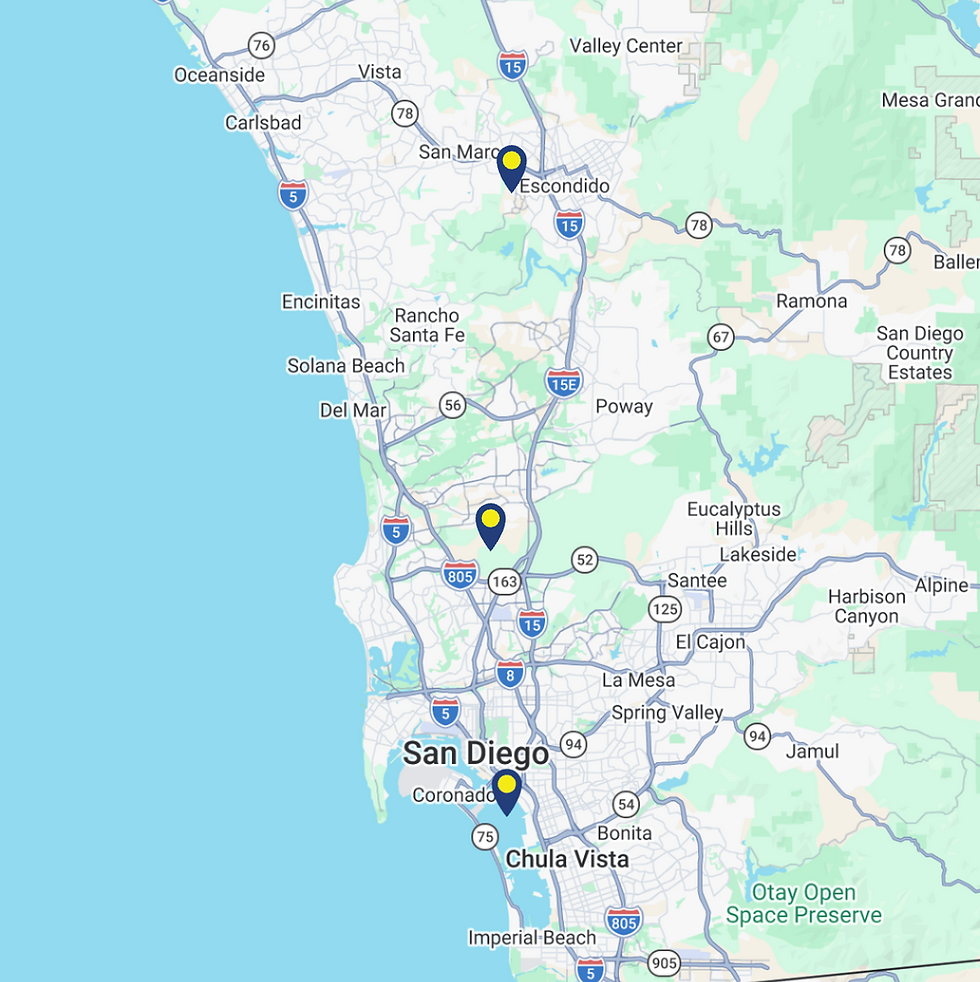
Zoom out, though, and the picture is bigger than local news coverage suggests. The state's own tracking body, CDFA's Citrus Pest & Disease Prevention Committee, publishes a cumulative tally that as of its most recent public count (May 2026) puts San Diego County at 111 confirmed infected trees across 66 sites in seven communities since 2021.
Almost all of it sits in two places: 75 trees across 47 sites in the area CDFA logs as "San Diego", and 24 trees across 10 sites in Valley Center. The rest is spread thinner — Oceanside (9 trees), Ramona (2), Fallbrook (1, not yet counting the second tree found this August) — plus two sites in Pauma Valley and Vista where the psyllid turned up but no infected tree has been confirmed.
It's still small next to the state's cumulative total of roughly 10,600 infected trees across 6,638 sites, concentrated in Los Angeles and Orange counties. No source we found breaks the county total down by residential yard versus commercial grove; the individual detections that did make local news — Oceanside, Rancho Bernardo, Fallbrook, Ramona — were each described as residential, but at 111 trees across 66 sites, that can't be assumed to hold county-wide.

That's not evidence the disease has reached San Diego's citrus industry — the county's crop reports still don't attribute any of the sixteen-year acreage decline to it. It is evidence the state has been running a large-scale containment effort, maybe even larger than the headlines implied, and each new quarantine zone adds more growers to the compliance list regardless of whether their own trees are affected.
Even if HLB isn’t a widespread problem for San Diego growers yet, the increasing compliance costs certainly are.
What it means for your bar or kitchen
Less local fruit, at a real premium. With local lemon acreage down 44% from its 2010 peak, there's simply less San Diego-grown fruit to go around, and what's left carries a real premium over imports. If your menu leans on "local" citrus, it's worth knowing how much of what you're pouring is actually grown here versus routed in from Ventura, Mexico, or further south.
Two separate sources of volatility. Price volatility on lemons doesn't look like it's going away either, and that's mostly about water costs, land pressure, and labor — the same structural forces that shrank the acreage in the first place. The disease risk is a second, separate thing to watch: still confined to a small number of residential trees so far, but each new quarantine zone adds more growers to the compliance list, and a single positive tree in a commercial grove would change that math fast.
"Local" is doing a lot of work. "San Diego lemon" and "lemon sold in San Diego" are two different claims, with a gap between them that's probably only going to widen. We couldn't find any public data on how much of what moves through local distributors is actually grown here versus imported in — that number doesn't seem to exist anywhere public, which says something on its own.
Worth watching all three if citrus is any real line on your cost sheet.
We'll be watching how the new compliance agreements play out over the next few months, and whether the county's next crop report shows the acreage decline continuing, holding, or — less likely, but not impossible — reversing. If you're a grower, packer, or distributor working in San Diego citrus and want to talk through what this looks like from where you sit, we'd like to hear from you.

Comments