Getting the Most from UGC: A Food & Beverage Guide Part II

Part II delves into the solutions available when pursuing UGC & influencer marketing for the food & beverage space, with specific recommendations for San Diego.
In Part I, we looked at whether UGC and influencer marketing actually make sense for your food or beverage business. If you've decided the answer is yes, this blog walks you through the next steps.
The right opportunity will be the creators who reach the right people, create content that fits your brand, and build partnerships that generate value beyond a single Instagram post. Here's how to approach it.
This blog discusses:
How to assess potential collaborators
How to determine pay and budget
Contract requirements: usage rights and details
Tracking metrics
Top TikTok and Instagram influencers in San Diego
How to Assess UGC Collaborators
In Part I, we discussed some of the questions that you should be asking before deciding on moving forward with UGC or influencer marketing. These questions will also help you narrow down who is best to work with.
The first key differentiator is content vs audience access.
If you need content, it’s best to look for creators who make high-quality videos, photos or other assets that you can potentially reuse on your own channels. Their follower count may be less important.
If you need reach, the creator's audience becomes much more important. You would want to know where their followers live, who they are, what types of content their audience engages with, and how much engagement they receive.
Let’s dig a little deeper into investigating audiences.
Some of these questions can be determined by looking through their follower numbers or the creator’s profile on sites like Collabstr and Upfluence. And if you can’t answer them yourself, reach out to them directly for an overview of their audience.
Is their audience local?
What are the demographics of their audience? E.g. are they hitting your target audience of college students, families, luxury travelers, etc.
Is their audience engaged? Are posts getting shared and reposted? Are people interacting in the comments about the content of these posts?
Does the creator work regularly with food businesses? This helps you determine if they their audience will be expecting this type of content from them, or also if they are posting competing content.
Micro-Influencers Can Make a Lot of Sense
An important thing to note, you don't need to work with the biggest creator in San Diego. Micro-influencers–generally creators with smaller but more focused audiences–can be particularly useful for independent businesses.
They may offer:
More engaged audiences
More specific niches
Stronger local connections
More accessible pricing
More opportunities for ongoing partnerships
For example, a neighborhood restaurant might benefit from a creator who has built an audience around North Park, Little Italy or Convoy rather than a general food account with a much larger but less geographically focused audience.
How Should You Compensate a Creator?
Pricing can vary dramatically depending on audience size, content quality, number of deliverables, and exclusivity/usage rights. Here are a few options for how to price a package:
Compensation Type | Example |
Product or experience | Complimentary meal, event experience, or product shipment. |
Flat fee | A set payment for an agreed upon number of deliverables. |
Product + fee | Combination of complimentary product and monetary compensation. |
Affiliate or commission | Compensation based on tracked sales or referrals. |
The important thing is to establish expectations before the collaboration happens. Don't assume that giving someone a free meal means you automatically own the content or have permission to use it in an advertisement.
Get Clear About Usage Rights
This is one of the most important, and frequently overlooked, parts of creator marketing. If a creator makes a video for your business, determine what you're allowed to do with it.
Can you:
Repost it to Instagram?
Post it to TikTok?
Put it on your website?
Include it in an email?
Use it in paid advertising?
Edit it into another video?
Use it for six months?
Use it indefinitely?
Those are different rights. If you're specifically hiring someone to create UGC for your business, usage rights should be part of the agreement. The more ways you want to use the content, particularly for paid advertising, the more important it is to establish those rights clearly.
Give Creators a Brief, Don’t Give a Script
Once you've selected a creator, give them enough information to succeed without trying to control every word they say. A simple creator brief might include:
Business:Who you are and what you do.
Campaign objective:What you're trying to accomplish.
Product:What you want them to experience or feature.
Key information:Important facts, pricing, location, hours or launch dates.
Things to highlight:The two or three things you most want people to understand.
Things to avoid:Anything inaccurate, outdated, or off-brand.
Deliverables:Exactly what content you're expecting.
Posting requirements:Where and when the content should be posted.
Usage rights:How your business can reuse the content.
Track What Happens: The Importance of Metrics
The planning for this step should have already happened when you were defining the goals of your campaign. You established your target audience, whether you wanted people to land on your Instagram and use a discount code. Once a campaign has run, it’s important to intermittently track metrics in the first few days and weeks.
Category | Key metrics |
Awareness |
|
Engagement |
|
Traffic |
|
Sales |
|
Tip: For a local business, you can also simply ask customers:
"How did you hear about us?"
It's not a perfect attribution, but it can give you useful information.
San Diego Creators to Consider
San Diego has a large ecosystem of food, beverage, lifestyle and local discovery creators. This is not a definitive ranking, it’s just a starting point for research. Follower counts and engagement change, so check each creator's current audience and recent content before reaching out.
In addition to this list, check out influencer marketplaces like Collabstr or JoinBrands. Or search hashtags like #SanDiegoEats #SDFood to see who is making content relevant to your area and product-type.
TikTok
@thetacofiend - The Taco Fiend
If you're a Mexican food, taco or beverage business, The Taco Fiend is one of the larger food-focused TikTok accounts worth knowing. Current influencer data lists the account at roughly 865,000 followers, with a reported 13%+ engagement rate.
The scale makes this more of a major-reach play than a traditional small-business UGC creator.
Best fit: tacos, Mexican food, street food, regional food and highly visual dishes.
@alsonlovesfood - Alson Loves Food
Alson Loves Food is a San Diego food creator focused on food reviews and recommendations. Current TikTok data lists roughly 61,000 followers and a reported 5.2% engagement rate.
Best fit: restaurants, food products and businesses looking for a smaller but engaged food-focused audience.
@zardapuya - Zard Apuya
Zard Apuya combines food and art content and is another San Diego creator worth exploring. Current creator data lists roughly 34,000 TikTok followers, with engagement reported at a particularly high level.
Best fit: visually distinctive food, culturally interesting concepts and brands that want something beyond a conventional restaurant review.
@chris.and.ashley - Chris & Ashley / SDFoodies
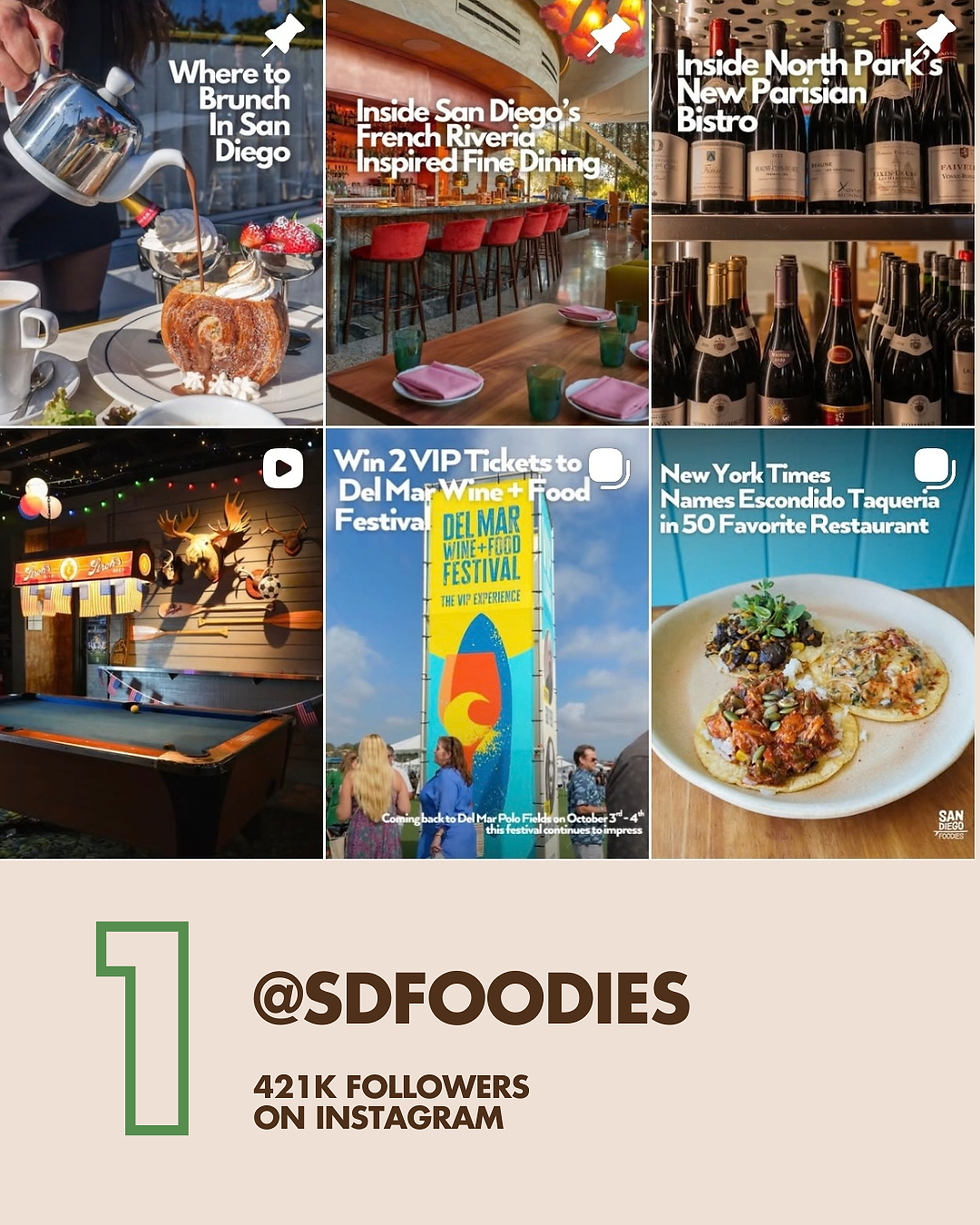
SDFoodies has built one of San Diego's most established food-and-experience creator brands. The company currently describes its Instagram audience as more than 420,000 and its TikTok presence as a separate short-form channel focused on fun, viral content.
SDSU Magazine reported in 2026 that the brand had grown to more than half a million followers across Instagram and TikTok and was working with hundreds of restaurants and clients throughout the region.
Best fit: restaurants, hospitality, events, experiences and brands that want significant local reach.
Instagram is particularly useful for food and beverage because Reels, photography and Stories allow creators to combine discovery with a more polished visual presentation.
@whatericacraves - Erica Costello

Erica Costello focuses on San Diego and Southern California food, travel, hidden gems and experiences. Current creator databases list her at roughly 115,000 Instagram followers, making her one of the larger local food-focused creators.
Best fit: restaurants, hotels, experiences, new openings and visually appealing food or beverage brands.
@lorenawinediary - Lorena Gutierrez Woods
For beverage companies, Lorena Gutierrez Woods is particularly relevant. Her content focuses on food, wine and travel, and current creator listings put her Instagram following at roughly 113,000.
Best fit: wine, cocktails, breweries, restaurants, hospitality and premium food/beverage products.
@marvelousmuncher - Vince Lymburn
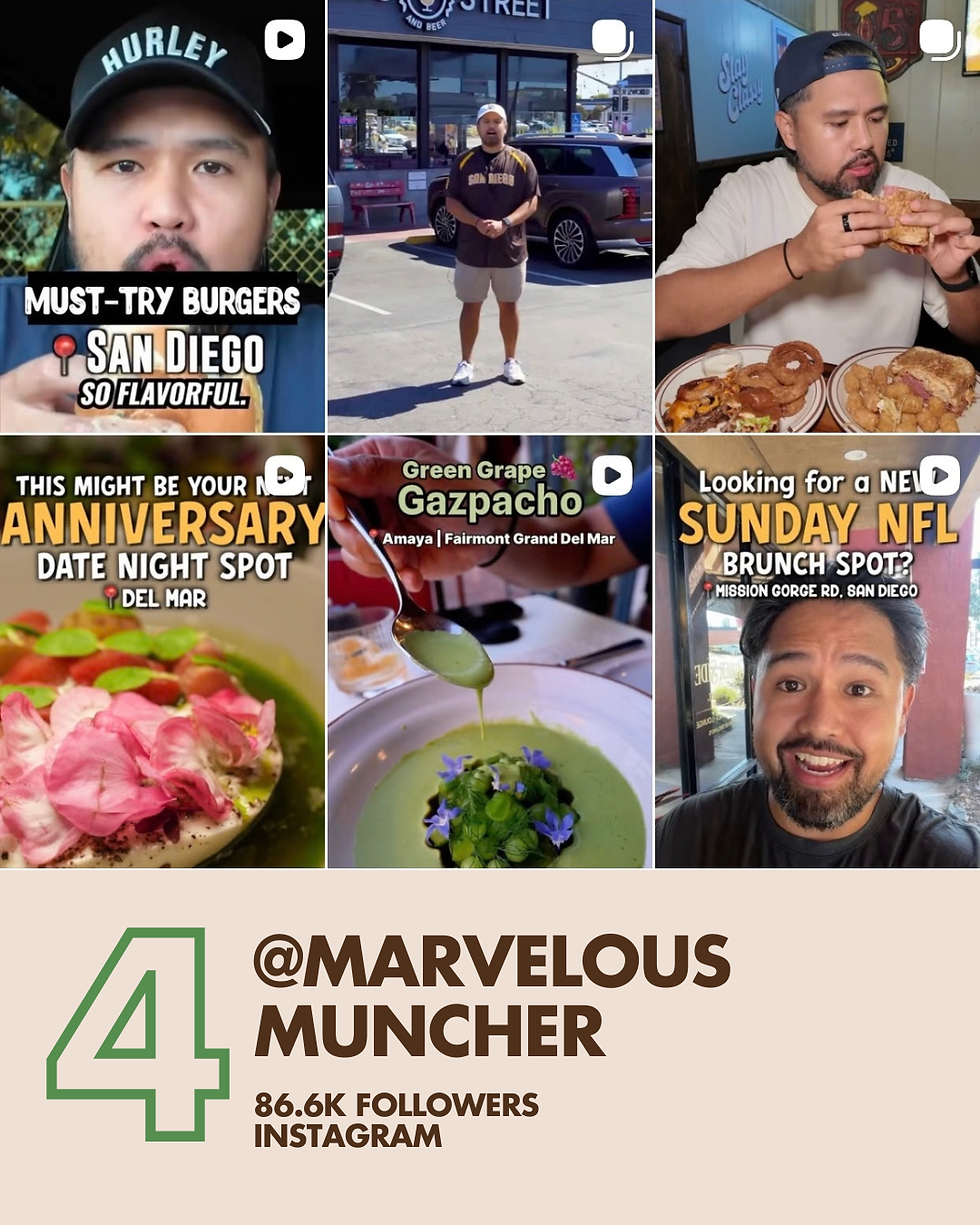
Vince Lymburn's Marvelous Muncher account focuses on San Diego food and hidden gems, with current listings putting the account at roughly 86,000 followers. His background in marketing also makes the account particularly interesting for businesses looking for content that feels more strategically produced than a simple food review.
Best fit: restaurants, hidden gems, food launches and businesses looking for both content and local discovery.
@sandiegofoodiefan — Darryl Gordon
Darryl Gordon has built a San Diego-focused food audience around restaurants, food events and local businesses. Current listings put the account at roughly 65,000 followers. His account has also been highlighted by San Diego Magazine as a local food influencer with a strong focus on San Diego restaurants and family-run businesses.
Best fit: independent restaurants, family-owned businesses and local food brands.
@sandiegoeaters — Samantha Jacksich
Samantha Jacksich focuses specifically on San Diego food spots and restaurant discovery. Current data lists roughly 57,000 followers, with average Reel plays reported at more than 50,000.
Best fit: restaurants, openings, new menu items and businesses trying to reach people actively looking for places to eat.
@sandiegofoodgram — Stephanie Dupuis
Stephanie Dupuis identifies herself as a San Diego foodie and UGC creator covering food, drinks and local events. Current listings put the account at roughly 11,500 followers. This is a good example of why businesses shouldn't automatically dismiss smaller accounts. A creator who explicitly offers UGC may be valuable not because of their follower count, but because they can create content that the business can use itself.
Best fit: smaller restaurants, cafes, bars, packaged food brands and businesses looking for affordable content creation.

Comments